
Becoming One Team:
How Versova Created a Culture Built to Last
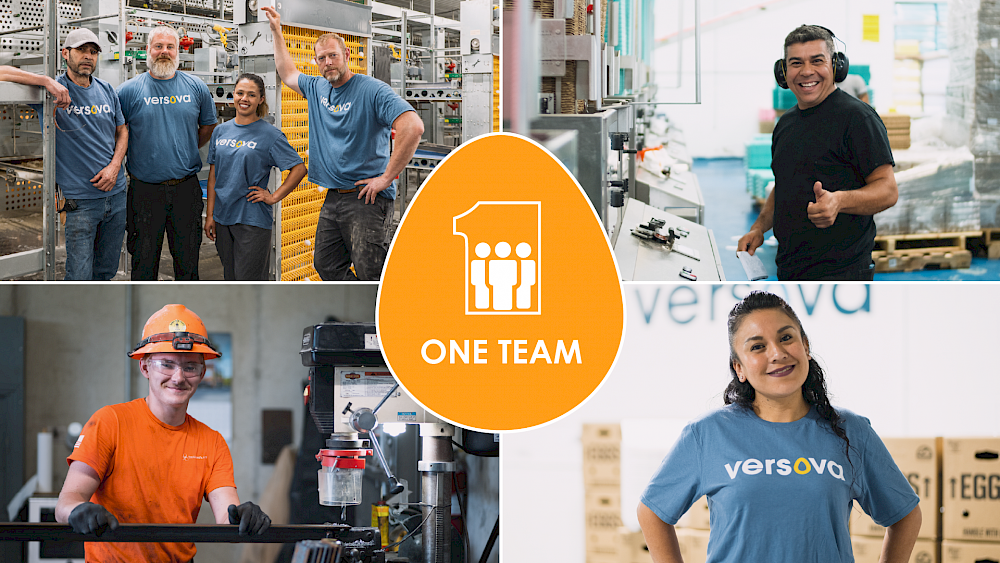
Every company has a culture. The difference is whether it happens by accident or by design.
Versova’s founding families have always known who they are: how they treat people, how they make decisions, and what they stand for. Their shared values are woven into the fabric of their business.
But when they came together to form Versova, that identity needed language – a way to translate a culture that worked on a smaller scale to an organization that would someday span multiple states and hundreds of employees.
“Our core values represent our True North and are the filter through which we make critical business decisions,” says Versova Executive Vice President Doug Mack. “They set the expectations for every employee – and for how we engage with each other.”
The framework defining Versova’s culture didn’t come together overnight. It took almost a year to complete – full of long meetings, careful debates over language, and hard conversations about who Versova was and how it wanted to operate.
Building a Leadership Culture
The work started in 2015, before Versova even had a name. Doug Mack joined Trillium Farms in 2013, bringing with him a clear understanding of the importance of embedding values into a company culture. Chuck Renken, now chief people officer, was also based at Trillium. He remembers Mack pushing early to develop defined values that would create a strong foundation and position the companies for growth.
“Doug was a big driving force,” says Renken. “He knew that we needed to decide who we are and then tell everybody who we are.”
When Mack began overseeing Centrum in 2015, he and Renken started talking about expanding those ideas beyond a single farm. They wanted to build a culture that could scale.
“We saw an opportunity to do things differently,” says Mack. “To build a culture that cared deeply about people and held high standards for results – and to make sure that culture scaled as we grew.”
They started small—just the two of them—then brought in a committee to pressure-test their thinking. Eventually, they took the framework to leadership for feedback.
From the beginning, one thing was clear: if they were going to do this, they had to get it right. These couldn't be words on a poster that employees walked past every day without noticing. They had to mean something – and both leadership and employees had to live them.
"There were a lot of meetings going through these words and definitions," Renken recalls. "We wanted to be sure they said exactly what we meant. Many long hours were spent on this."
The debates over language were complex, but nobody wanted to rush the process. Every phrase had to reflect who Versova is—and who it aspires to be.
Introducing the Framework
By late 2016, the framework was ready. Doug Mack – then serving as Versova’s first COO – introduced the Versova Guiding Principles and Core Values to the teams at Centrum Valley Farms and Trillium Farms.
He answered a simple question: What is Versova?
-
One team with a shared vision across all farms
-
A company that stays true to its values
-
An organization built to exceed customer expectations and drive innovation
He presented the list of six principles and nine values that would be the foundation for who the company is, how it operates, and how it treats customers, team members, and communities.
That same year, Versova introduced a visual framework to bring it all together – the Egg.
Building the Egg
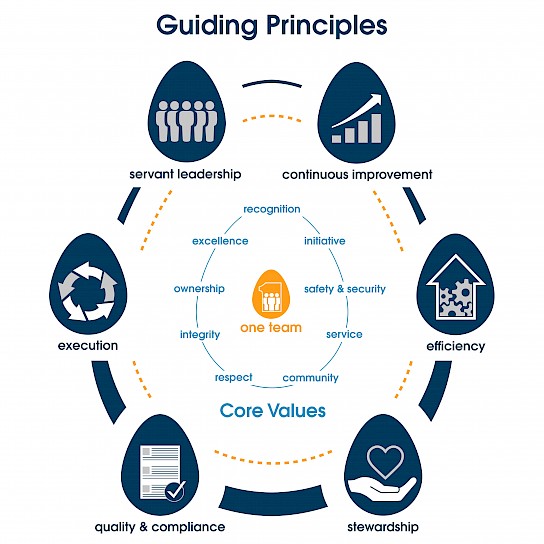
The shape was intentional. Six guiding principles form the outer ring. Nine core values sit inside. And at the center, two words: One Team.
The structure reflected how the values actually work together.
"Quality and stewardship are at the bottom because they're the foundation," Renken explains. "That's how you get to execution and efficiency. The core values are the fuel for how the outer principles work. You can't be a servant leader without respecting people. You can't be a steward without focusing on community. You have to have those inner qualities to be successful at the outer principles.”
The guiding principles set expectations for how the company operates. The core values made those expectations personal. Together, it gave every team member a clear picture of what Versova stands for – and what’s expected of them.
Culture would be a part of the system, not just a byproduct of it.
The Guiding Principles
The six principles work together. Here’s what each one means:
Servant Leadership — Leadership at Versova starts with a question: How can I help? It's a philosophy that inspires excellence at every level of the organization. Managers are expected to support their teams beyond basic direction — showing up at the farm, understanding daily challenges, and removing obstacles so people can do their best work.
Stewardship — Develop, care for, and preserve the natural, human, and financial resources entrusted to the organization. The families who built Versova think in generations, not quarters. It's a mindset rooted in farming, where you preserve and grow what you have so your children inherit something better.
Quality & Compliance — Consistently meet or exceed requirements, standards, and best practices. Every egg that leaves a Versova facility carries the company's reputation with it. Quality and compliance are everyone’s job, not just the responsibility of the compliance team.
Continuous Improvement — From a stable operating platform, constantly find better ways to get things done. Small, meaningful changes add up to better outcomes over time.
Execution — Perform your job-specific tasks with quality and integrity, enabling the business to meet its potential. It's the commitment to follow through, meet deadlines, and deliver on promises to customers, partners, and each other.
Efficiency — Find the best ways to achieve maximum results by leveraging finite resources. The focus is on reducing waste, optimizing processes, and making smart investments that pay off over time.
****
For Mack, servant leadership sets the tone for everything that follows.
“It starts with putting others first,” Mack says. “You do that by showing up, listening, and doing whatever you can to help your team succeed. And it’s not just our leaders who are expected to act this way. Any team member can ask ‘How can I help?’ in any situation.”
Servant leadership has always been at the heart of agriculture and has shaped all levels of Versova – from the founders to leadership to farm workers.
The Core Values
The Guiding Principles defined how Versova would operate as a company. The Core Values defined how individual team members would bring that operation to life.
Initiative — Be self-directed and proactive in examining your work environment and acting to improve it.
Integrity — Be fully transparent by adhering to personal moral and ethical principles, along with moral and ethical standards of business.
Ownership — Accept accountability for actions and take pride in all you do.
Respect — Treat colleagues exactly how you would like to be treated — with honesty, dignity, and professionalism.
Excellence — Always perform at individual and collective potential to be the premier egg producer.
Safety/Security — Ensure a safe, clean, and secure environment for all personnel, poultry, and products.
Recognition — Celebrate the efforts and accomplishments of the team.
Service — Possess an attitude of servant leadership at all times — How can I help?
Community — Through cooperative efforts and proactive engagement, enrich the communities where Versova operates by always being a good neighbor.
****
For Renken, the last core value carried personal weight.
"Community was particularly important to me—not just externally, but internally," he says. "You have to build relationships with the people you work with. If you don't work well with others, you're not building community."
These definitions gave employees a clear picture of what was expected – and leadership would hold itself to the same standard.
One Team
Asking people to consistently do the right thing is easier when they're part of a culture that reinforces it.
When the framework was first introduced, One Team was simply what surrounded the Egg—a reminder that the values only work when everyone commits to them together.
Over time, it became something more.
“One Team started as the phrase that tied everything together,” Mack says. “But it became its own thing – almost like the seventh value. It’s the one that holds all the others in place.”
Today, One Team is its own philosophy about how Versova operates. It ties Versova’s Guiding Principles and Core Values together. And it captures the idea that Versova is one company, working toward common goals, regardless of what farm someone works for or what state they call home.
"We have a culture of really smart people who are good at solving problems—and who are genuinely good people," Renken says. "They care about their teams, and they treat them that way. There's not a person here who wouldn't help if someone said they needed it."
It’s one thing to put values on a wall – it’s another thing to build your company around them.
That philosophy became even more concrete in 2025, when Versova transitioned to a new structure: the Versova Management Cooperative. The change formalized what the company had been practicing all along—shared leadership, shared responsibility, and shared ownership of the outcome.
The Refresh
As Versova has grown—welcoming new farms, new team members, new ways of working—Mack and Renken have revisited how these principles and values are articulated.
"We want this to connect with team members at every level – from the farms to leadership,” Renken says. “That’s the goal of the refresh: to make it accessible for everyone.”
What mattered in 2016 still matters today. But as the organization has grown, so has the need to make sure the language is clear and consistent. That's what prompted a fresh look at the guiding principles and core values.
The refresh will also bring clearer, simpler language to each value—and practical examples of what they look like in daily work, whether that's on the farm floor, in the processing plant, or in the office.
The goal is to make the values accessible to every team member, regardless of role, location, or primary language.
The substance remains the same. The work still gets done every day as One Team. The commitment to doing what's right remains firm.
Ten years in, Versova knows exactly who it is. The refresh brings the words in line with what the founding families knew mattered most: living shared values, every day.
Source: https://www.versova.com/blog/becoming-one-team-how-versova-created-a-culture-built-to-last/