
Committed to Safety:
How Versova's Dedication to Food Safety Grew with the Company
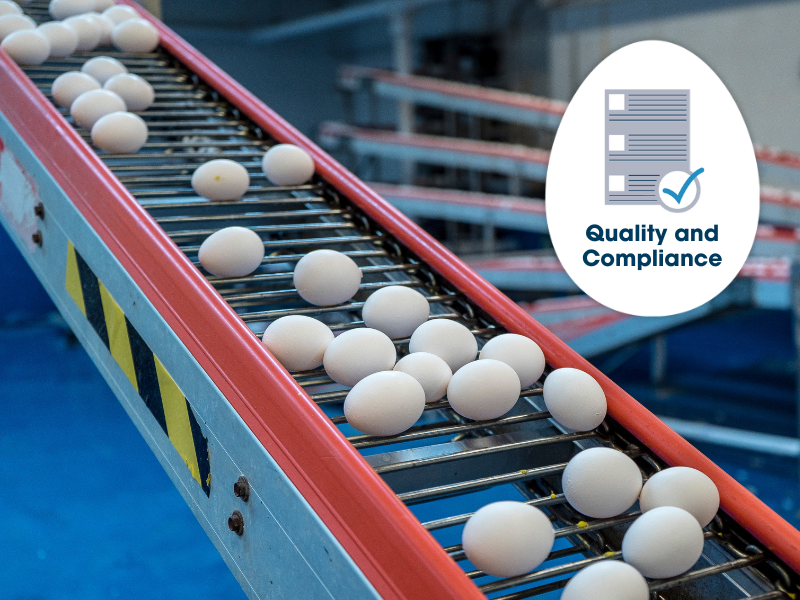
Every egg that leaves a Versova location carries the company’s reputation with it — and decades of accumulated knowledge about how to produce safe eggs.
Across Versova’s farms, few responsibilities carry more weight than the safety and quality of each customer order. Food safety at Versova started the same way everything else did: with farming families who held themselves to a high standard because their values compelled them to do so. It’s woven into the culture and backed by rigorous compliance.
“At Versova, we do the right thing. And we do what we say we do,” says Ashley Pinkerton, senior director of compliance. Pinkerton has spent 12 years in food safety, starting in processing as a quality assurance specialist. She now leads Versova’s national compliance team.
“Our food safety and quality team is incredibly thorough,” she adds. “Leadership support for what we do is there 100%, top down, every step of the way.”
Safety as a Founding Principle
Long before Versova had a name, the founding families were building a reputation based on quality and trust. In an industry where consumer confidence is everything, they operated with a simple understanding: the eggs leaving their farms were feeding families just like their own.
That mindset became embedded in how Versova operates. When the company formalized its core values in 2016, “Quality & Compliance” were central elements. As the company grew and took on management of additional farms, the same standards followed.
Versova’s compliance team is deeply committed to producing safe, quality eggs. The team is on the floor, at the farms, and working with operations every day to ensure transparency with customers and integrity in every process.
Rising Standards, Stronger Practices
When customers purchase eggs to sell or serve, they expect those eggs to be safe. Whether they’re headed to a family’s table, a restaurant menu, or further processing, meeting that expectation has always been the goal.
Over the years, food safety practices have grown more sophisticated. Scientific understanding of foodborne illnesses deepened, which led to better detection and prevention. Across the industry, producers have invested heavily in food safety infrastructure.
“When I started my career, everything was manual,” Pinkerton recalls. “I’ve seen egg producers embracing modern technology.”
The industry received more formal guidance in 2009 when the FDA Egg Safety Rule established prevention-based requirements for shell egg producers, specifically for production, monitoring and testing for Salmonella Enteritidis (SE).
“The FDA Egg Rule is one of the most important and impactful developments in egg safety,” says Oscar Garrison, senior vice president of regulatory affairs at United Egg Producers. “Egg producers value this clear direction and have implemented comprehensive protocols across their farms to comply with its provisions.”
The rule marked a turning point for the industry. And compliance with these federal requirements is something Versova takes seriously.
Safety at the Source
Food safety starts before an egg is ever laid.
Versova’s farms source pullets from SE-negative breeder flocks meeting National Poultry Improvement Plan standards. Pullets are tested between 14 and 16 weeks of age, before they ever start laying. It’s a prevention-first approach required by the FDA Egg Safety Rule that addresses risk at the source. Required SE testing of hens is repeated at 40-45 weeks of age.
Farm compliance specialists oversee multiple sites, managing the daily work required by the FDA Egg Safety Rule to keep eggs safe at the source. They focus on preventing SE from ever entering the environment. That means enforcing disease prevention protocols, managing pest control programs, and conducting ongoing environmental monitoring for SE.
“The work happening in our barns is critical,” Pinkerton says. “Prevention is the strongest tool we have. If we follow requirements and stop issues before they start, we protect our hens, our eggs, and ultimately the consumer.”
From Farm to Processing
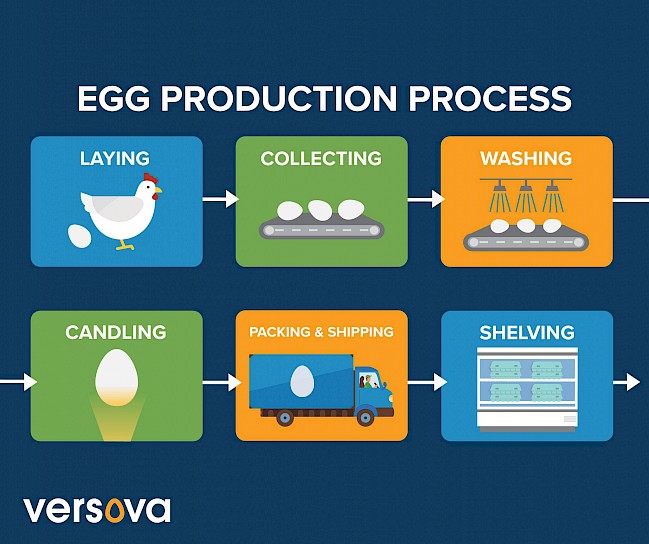
Once eggs leave the barn, oversight continues. Eggs must be refrigerated within 36 hours of lay per the FDA Egg Safety Rule. At breaking and further processing plants, the USDA’s Egg Products Inspection Act governs food safety requirements. A food safety manager evaluates risk across the entire processing flow. From washing to breaking to packaging, every stage has a plan to identify and mitigate potential hazards. Quality assurance teams monitor these controls daily.
All of Versova’s breaking and processing facilities follow regimented Hazard Analysis Critical Control Point (HACCP) food safety plans. Beyond federal regulations, Versova also pursues voluntary programs like Safe Quality Food (SQF) certification in food safety and quality. Third-party auditors are regularly scheduled and invited to observe and verify the work.
“We want that independent confirmation. Compliance is the baseline,” says Pinkerton. “We pursue these programs because we want to be held to a higher standard — and because that’s our commitment to our customers.”
Ashley Pinkerton has seen these protocols from every angle. Before overseeing national compliance, she was on the floor, learning the process from the ground up at Trillium Farms. Today, she leads a team structured to support every Versova location.
“It’s constant collaboration,” she explains. “Our quality assurance team monitors food safety controls, partners with operations, and runs monthly reviews. It takes time and effort to build these programs, and they require continuous upkeep. Compliance is never ‘done.'"
The results speak for themselves. Versova maintains 100% passing scores on food safety audits across operations. Behind every program and protocol are people committed to making it work — and making it better.
A Culture of Continuous Improvement
Food safety in egg production has long been a collective industry commitment. For decades, producers have worked together on research, education, and protocols with the goal of preventing foodborne illness.
“America’s egg farmers have been collaborating with regulatory agencies, including FDA and USDA, to ensure the safety and quality of eggs produced on their farms,” says Garrison.
United Egg Producers (UEP) is at the center of that effort, strengthening food safety practices industry-wide, providing training and education, and connecting producers with the regulatory community. Versova participates actively in UEP initiatives alongside other producers with a common intention: ensuring consumers can trust the safety of the eggs on their table.
Looking Ahead: The Future of Traceability
The next chapter in food safety builds on principles the industry has long valued: transparency, accountability, and the ability to trace food back to its source. The FDA’s Food Traceability Rule (known as FSMA 204) formalizes those principles, with a compliance deadline of July 2028.
Meeting the rule’s requirements demands technology that can track every egg from farm to customer. Versova has been investing in systems designed to digitize and automate traceability by capturing data at every stage of production — from egg origin through processing and shipping.
“It’s all about modernizing traceability,” Pinkerton says. “We want to get it right from the start. When the technology infrastructure is complete, we’ll be able to access that data within minutes.”
That investment positions Versova well for the future. But technology is only part of the equation. What sets Versova apart is the people and culture behind it.
Doing the Right Thing
A decade into Versova’s history, the commitment to food safety reflects the same values that have guided the company from the start. The tools have changed, and the scale has grown, but the purpose remains the same.
For Pinkerton, leadership starts with the people who do the daily work. “I have great pride in our team,” says Pinkerton. “They’re problem solvers who are committed to moving us forward.”
That sense of ownership shapes how Versova approaches every aspect of food safety — from daily sanitation protocols to long-term technology investments. The same philosophy that guided those early leaders decades ago now operates at a scale they could only have imagined.
As Versova marks its first decade, the commitment remains the same: doing the right thing, every day.
[Learn more about Versova’s programs here: Our Responsibilities]
Source: https://www.versova.com/blog/committed-to-quality-how-versovas-values-shaped-food-safety-and-compliance/