
Telling Our Story: How Versova Built a Sustainability Practice From the Ground Up
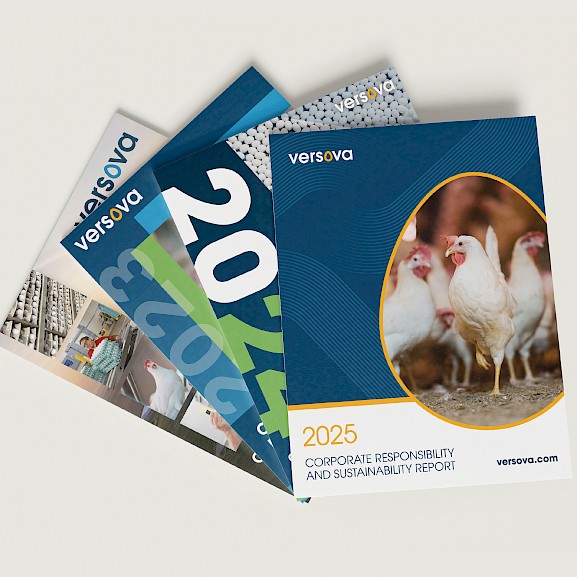
Every year, Versova publishes its sustainability report. The report offers a detailed look at how the company operates: the farms, the people, the animals, and the environmental practices that shape daily operations.
The annual report is the most visible output of Versova’s sustainability efforts, but it’s just one snapshot of the daily work happening across Versova farms and the company’s broader commitment to sustainable egg production.
“The report is how we tell our story externally,” says Emily Battilega, Versova’s director of sustainability. “But it’s also an internal tool. It shows us what’s working, what needs attention, and where we can do better. We use that data to drive decisions across our operations.”
The story of how Versova built its sustainability practice begins with cooperative leaders recognizing that transparency and accountability require more than good intentions — they require infrastructure.
Starting from scratch
In 2023, Versova published its first sustainability report with 2022 data. At the time, sustainability conversations were intensifying across the food industry. Customers were making commitments, consumers were prioritizing sustainability, and policymakers were paying attention.
Versova’s leaders recognized the need to communicate what the company was already doing: caring for animals, investing in people, and managing resources responsibly. They wanted to produce a report that would be thorough, meaningful, and easy to understand.
Emily Battilega was uniquely positioned to lead the effort. She has a background in farm operations as the former business unit leader at Willamette Egg Farms in Canby, Oregon. She also has a passion for analyzing data. Her experience on the farm gave her the context to understand what the numbers actually meant.
“I can take all of these numbers and interpret them as a subject-matter expert, not only in sustainability, but at the farm level using farm language,” Battilega says. “It’s about being able to translate why this data matters across different channels and audiences.”
That combination of operations expertise and data fluency proved essential when building the first report from the ground up.
“The information existed, but it was all on paper copy invoices,” she recalls. “For all of the Versova sites, I consolidated two years’ worth of data to gather relevant, accurate information for the first report.”
Building that baseline dataset required collecting utility bills, flock records, and production metrics, then standardizing information across multiple locations with different tracking systems. Battilega built an in-house sustainability database that consolidated the information and eliminated the manual tracking process.
The effort was intensive, but it established a foundation that would make future reports more efficient and more meaningful. The infrastructure also gave Battilega continuous access to operational data, allowing her to identify improvements and inform farm-level decisions year-round.
Building a system that works
From the beginning, Versova aligned its reporting with the US Roundtable for Sustainable Poultry & Eggs framework — an organization Versova helped found — which organizes sustainability efforts around three pillars: People, Poultry, and Planet.
That structure gave the report clarity and credibility. It also ensured Versova was measuring what mattered — not just to the company, but to the industry and to customers evaluating their supply chain sustainability.
“Our report is intentional about highlighting employee stories and operational successes,” Battilega says. “The continuous improvement projects are front and center. The report tells who we are as a company.”
Dr. Mickey Rubin at the American Egg Board has seen sustainability reporting evolve across the industry. He notes that producers like Versova, who invest in data-driven reporting, are helping build consumer trust.
“When producers share their sustainability stories, it creates consistency across the industry,” Dr. Rubin says. “That transparency helps customers and consumers understand how sustainability practices actually get implemented at the farm level. It creates a compelling narrative for the egg industry and its commitment to responsible production.”
Versova’s first report set the standard. Subsequent editions have built on it, diving deeper into employee-driven initiatives, animal welfare protocols, and environmental stewardship. Versova has been recognized with national awards, demonstrating the value of bringing the company’s sustainability story to life.
Awards validate the work, but transparency remains the primary goal.
Honest reporting, even when it’s hard
One of the most challenging aspects of sustainability reporting is deciding how to address setbacks. For Versova, that conversation has centered on Highly Pathogenic Avian Influenza (HPAI).
HPAI has impacted the egg industry for years, and Versova’s farms haven’t been immune. Outbreaks disrupt production, strain teams, and create variability in year-over-year data that is difficult to explain.
“When your baseline isn’t consistent, it’s hard to present that data and communicate externally about why it’s so different from the previous year,” Battilega explains. “Now we report on a per-dozen basis, which accounts for flock size variations and provides more consistent year-over-year comparisons.”
The report also directly acknowledges ongoing industry challenges like HPAI, recognizing difficulties while highlighting the team’s strengthened biosecurity protocols and rapid response capabilities.
“You have to maintain that balance to build trust with your audience,” Battilega says. “We have to be honest about what we struggle with as a company and an operation. We love celebrating, but we do have things we need to work on.”
That honesty resonates. Customers don’t want to just hear about wins. They want to know their suppliers are accountable and committed to continuous improvement.
Gathering stories, building trust
Each year, the process begins the same way: with conversations.
“Our farm leaders are my partners in this reporting, and the best way for me to get information is directly from the farm sites,” Battilega says. “I ask them what they’re proud of, but I’m also looking at the data to see where we can improve.”
She keeps a running list throughout the year capturing milestones and challenges as they happen. In November, she drafts an outline and begins pulling data. Some of it is now easier to access thanks to Versova’s growing data management team. Other information still requires manual collection and verification.
“The more I explore the data, I can see there’s a story to be told,” Battilega says. “I visit farm sites so I can gather context and tell those stories.”
One year, Trillium Farms reduced water use by 36% after identifying and resolving unnecessary usage spikes. Another year, Ovation Farms installed a grading machine to optimize egg sizing for different customer needs. The sustainability report highlights these farm-level successes, showcasing the work teams are doing to operate more efficiently and responsibly.
The 2025 report will also feature Richlawn-Revive, a business that demonstrates circular sustainability thinking by turning chicken litter into organic lawn and garden products co-located at Morning Fresh Farms in Colorado. It addresses what every egg farm faces: how to manage litter in ways that benefit, rather than burden, the environment.
“Making products that promote more sustainable lawn and garden care is only part of the equation,” says Vince Tessandori, general manager of Versova’s Mountain Region, including Richlawn-Revive. “We are also committed to making these products in the most sustainable ways possible.”
In 2025, work began on a second production site in Washington state, extending the reach of products that improve soil health where grass grows. Better soil structure means less fertilizer and water are needed for a healthy turf.
These stories matter because they demonstrate how Versova makes informed, practical changes while highlighting the people leading the company forward.
Sharing the report
Versova’s sustainability report serves multiple purposes: communicating practices to stakeholders while creating internal accountability that drives improvement. For Battilega, the motivation for creating the report is deeply personal.
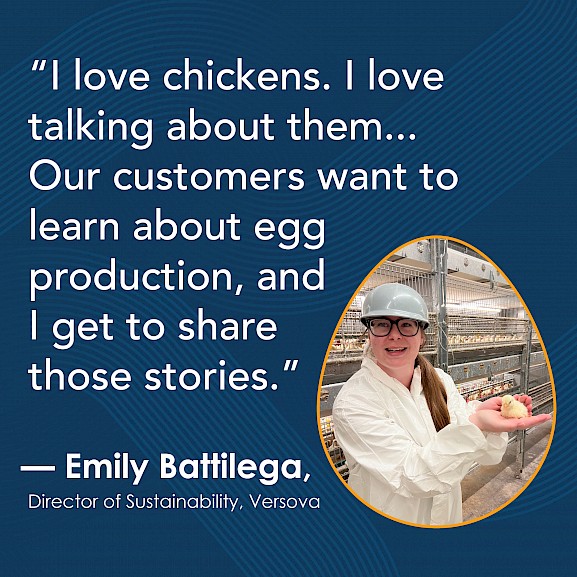
“I love chickens. I love talking about them, but there’s not always a channel for people to listen,” she says. “It’s what drew me to sustainability in the first place. Our customers want to learn about egg production, and I get to share those stories. It’s a chance to give our teams credit for all they’re doing to make a difference.”
Customer feedback has been consistently positive. The report demonstrates that sustainability is embedded in how Versova operates, opening doors to potential collaborations.
“I want our customers to see that as their supplier, Versova is helping them meet their goals,” Battilega says. “I want them to read this report and come back to us with partnership opportunities that meet our shared sustainability goals.”
Looking ahead
As Versova continues to grow, so will the scope and sophistication of its sustainability reporting. The company’s data management capabilities are improving, which will allow for deeper analysis and more comprehensive tracking.
Battilega sees potential for the report to play a larger role in industry-wide efforts. She’s worked closely with the American Egg Board on initiatives like ‘Incredibly Sustainable,’ a tool that helps producers benchmark and share their sustainability practices. As an egg producer voice on the organization’s sustainability task force, she helps develop content and calculators for greenhouse gas emissions and sustainability reporting.
The focus on people-centered data is particularly important, according to Dr. Rubin.
“Sustainability isn’t just about environmental metrics,” Dr. Rubin notes. “This comprehensive approach of prioritizing your workforce, investing in your communities, and caring for your poultry all play a role in operating sustainably. Meaningful reporting demonstrates what that looks like in practice.”
Battilega’s commitment to this work earned her recognition as the 2025 recipient of American Egg Board’s ‘Breaking Through’ Award.
“The more producers we have out there using these tools, the better alignment we’re going to have in the egg industry around sustainability,” says Dr. Rubin. “That builds trust in egg farmers and in the eggs they produce for customers and consumers.”
For now, Versova’s commitment remains the same: Publish a report that’s accurate, data-driven, and reflective of the company’s values.
“We said when we started that this is the right thing to do, and we are in this for the long haul,” Battilega says. “We see that sustainability efforts have tangible business advantages for us, and we’re committed to sharing about them with our partners.”
Versova’s 2025 Sustainability Report is available to read here.
Source: https://www.versova.com/blog/how-versova-built-a-sustainability-practice-from-the-ground-up/